PUBLISHED ON:
December 15, 2025

AI-Enabled Patient Interaction Intelligence for a Leading Hospital Chain in South Africa

Hero Image

Executive Summary

A multi-facility private hospital group in South Africa faced operational inefficiencies and compliance risks due to fragmented communication between its cloud-based telephony platform and its patient service management system. Patient calls, appointment inquiries, billing disputes, and clinical coordination conversations were manually logged, resulting in inconsistent documentation, delays in escalation, and limited visibility into service quality. We implemented an AI-enabled integration and orchestration layer that connected the hospital’s telephony system to its service management environment, automatically generating enriched patient service cases from voice interactions.

Measurable Impact
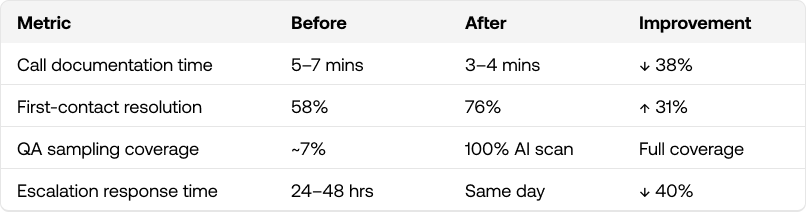
  • 38% reduction in call documentation time
  • 31% improvement in first-contact resolution
  • 100% automated compliance scanning of recorded calls
  • Enhanced POPIA-aligned auditability

The Business Challenge

The hospital group operates across multiple provinces and handles:

  • Appointment scheduling
  • Emergency follow-ups
  • Billing queries
  • Insurance authorisations
  • Clinical escalations

Key Pain Points

1. Manual Call Logging

Call centre staff manually entered case notes into the patient service system after each call.
Notes varied in quality and completeness.

2. Disconnected Systems

  • Call recordings stored in telephony platform
  • Service tickets stored in case management system
  • No automatic linkage between voice and case record

3. Compliance & Privacy Risk

Under South Africa’s Protection of Personal Information Act (POPIA):

  • Patient data handling must be traceable
  • Call documentation must be consistent
  • Sensitive information must be securely stored

4. Limited Supervisory Visibility

Supervisors reviewed only a small sample of calls due to volume constraints.

Our Approach

Rather than replacing existing systems, we introduced a secure AI orchestration layer between:

  • Cloud telephony platform
  • Patient service management system
  • Document repository
  • Compliance monitoring tools

This preserved existing investments while adding intelligence and automation.

Solution Architecture

Patient Call (Inbound / Outbound)

Telephony Event Webhook

Secure API Gateway

AI Processing Layer

- Speech-to-text transcription

- Clinical intent classification

- Sentiment analysis

- Compliance phrase detection

- Escalation risk scoring

Automated Service Case Creation / Update

Analytics & Governance Dashboard

Key Capabilities Delivered

1. Automatic Patient Case Creation

Every completed call automatically:

  • Created or updated a service case
  • Attached recording reference
  • Logged patient ID and hospital location
  • Tagged department (billing, admissions, pharmacy, radiology, etc.)

Manual note writing was reduced to review-and-approve.

2. AI-Generated Call Summaries

Each call was:

  • Transcribed securely
  • Summarized into structured clinical-service notes
  • Categorized by issue type
  • Flagged for urgency where required

This reduced administrative load on frontline staff.

3. Intelligent Escalation Detection

AI models flagged:

  • Distressed patient language
  • Clinical risk indicators
  • Escalation keywords
  • Repeat-call patterns

High-risk cases were automatically routed to senior nursing or administrative staff.

4. POPIA-Aligned Compliance Automation

The system:

  • Verified required consent language was used
  • Flagged disclosure risks
  • Ensured secure storage of transcripts
  • Logged tamper-proof audit trails

Supervisors gained full visibility across 100% of calls, not just random samples.

5. Operational & CX Analytics

Hospital leadership gained insights into:

  • Call volume by department
  • Sentiment trends by facility
  • Recurring billing disputes
  • Authorization bottlenecks
  • Escalation hotspots

This enabled proactive staffing adjustments and service improvements.

Results

Operational Performance

Results

Financial & Risk Impact

  • Reduced administrative overhead
  • Improved patient satisfaction scores
  • Lower compliance exposure
  • Faster resolution of billing and authorisation issues

Strategic Value

1. Structured Patient Interaction Data

Previously unstructured voice conversations became structured, searchable records.

This data is now used for:

  • Service optimisation
  • Predictive staffing
  • Training & quality assurance
  • Experience benchmarking across facilities

2. AI-Ready Healthcare Operations

The foundation now supports:

  • AI-assisted patient email responses
  • Proactive follow-up notifications
  • Predictive complaint detection
  • Workflow automation for authorisations

3. Scalable Multi-Facility Architecture

Because the orchestration layer was decoupled from core systems, the solution scaled seamlessly across provinces while respecting data governance requirements.

Governance & Security

Given healthcare sensitivity, we implemented:

  • Encryption in transit and at rest
  • Role-based access controls
  • Controlled transcript retention policies
  • Human-in-the-loop approval workflows
  • AI decision audit logs

The platform passed internal compliance review before full production rollout.

Why This Approach Worked

We did not disrupt clinical systems.

Instead, we:

  • Integrated existing tools
  • Added intelligence at the orchestration layer
  • Focused on measurable operational improvements
  • Ensured regulatory alignment from day one

This minimized risk while delivering rapid ROI.

Conclusion

By integrating telephony with the hospital’s service management system and adding AI-powered interaction intelligence, the hospital chain transformed fragmented patient communication into a structured, compliant, and insight-rich engagement platform. The result was faster service, improved patient experience, and stronger regulatory posture without replacing core systems.